
The sun was barely up, casting a soft, warm light over the neighborhood as Marlon Davis prepared for another day of work. He moved through his modest home quietly, careful not to disturb his wife, Angela, still sleeping upstairs. Despite the early hour, Marlon enjoyed these quiet moments, savoring a few minutes of calm before starting his daily school bus route. With a hot cup of coffee in hand, he took a deep breath, feeling a familiar sense of purpose wash over him. As he looked out the window at the neighborhood he called home, Marlon had no way of knowing that today would be anything but ordinary.
As a school bus driver for over fifteen years, Marlon had seen it all. He loved the job, not just because he enjoyed driving, but because of the kids. The children who boarded his bus each morning came from a range of backgrounds, many of them from neighborhoods like his own, where opportunities weren’t handed out freely, and life was often tough. Marlon took his responsibility to heart, making sure the time they spent on his bus was safe and comfortable. He’d always thought of himself as more than just a driver—he was a guardian, a role model, and for some, even a father figure.
Finishing his coffee, Marlon grabbed his jacket, slipped out the door, and started walking to the bus depot. As he stepped outside, the cool morning air greeted him, fresh and crisp, stirring a feeling of calm inside him. The streets were quiet, with only a few early risers heading to work, some of whom Marlon knew by name. He greeted them with a nod, sharing a quick smile before continuing on his way.
Upon reaching the depot, Marlon walked among the familiar line of yellow buses, each one waiting patiently for its driver. The depot buzzed with the sounds of engines warming up, drivers exchanging friendly greetings, and the smell of coffee wafting through the crisp morning air. Marlon exchanged nods and waves with his fellow drivers, a sense of camaraderie in their shared routine.
As he approached his own bus, Marlon paused, running his hand along the side, checking for any dents or scratches from the previous day. It was a habit he’d developed over the years—an act of care and attention that made him feel in control. Satisfied that everything was in order, he climbed into the driver’s seat, took a moment to adjust his mirrors, and started the engine. The familiar rumble beneath his feet felt comforting, a reassuring constant in an unpredictable world.
Marlon began his route, weaving through the neighborhood, stopping at each designated stop to pick up his young passengers. The bus quickly filled with the sounds of laughter, chatter, and the occasional argument—an atmosphere he had come to cherish. He knew each of the kids by name, knew their stories, their dreams, their struggles.
There was Darius, the aspiring basketball star who never missed an opportunity to talk about his favorite players and practice his moves in the aisle; Leila, the quiet one who always sat at the front, nose buried in a book; and Marcus, the class clown, whose infectious laughter often lifted the spirits of everyone around him. Each of these kids held a special place in Marlon’s heart, and he took pride in being someone they could count on.
As they neared the last stop, Marlon felt a wave of contentment wash over him. Today seemed like it would be just another routine day—until he noticed a police car trailing the bus, its lights off but clearly keeping pace. At first, he didn’t think much of it; after all, it wasn’t unusual for a patrol car to follow a school bus to ensure safety. But as they continued, the police car remained behind, never changing its position.
A subtle unease crept into Marlon’s stomach as he made another turn. That’s when the police lights suddenly flashed on, casting a bright red and blue glow inside the bus. The siren blared for a brief moment, signaling him to pull over. The bus fell silent, the chatter abruptly cut off as the kids looked out the windows, confusion and fear on their faces.
Marlon’s hands tightened on the steering wheel. He could feel the kids’ eyes on him, waiting for him to say something, to offer an explanation. “Stay seated, everyone,” he said, trying to keep his voice calm and steady. “This will only take a minute.”
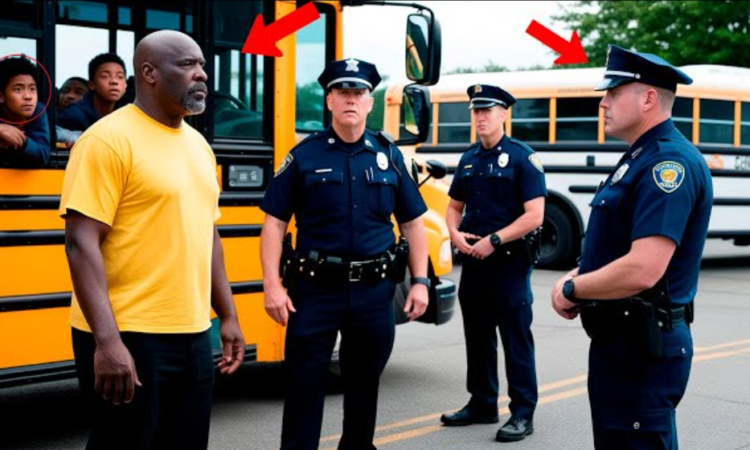
He pulled the bus to the side of the road, watching in the rearview mirror as two officers stepped out of the police car. They approached with slow, measured steps, their expressions unreadable but tense. A sense of dread settled in Marlon’s chest. He’d been pulled over before, but this felt different.
One of the officers, a tall man with a buzz cut, reached the driver’s window and tapped on it with more force than necessary. Marlon rolled down the window and looked up at him, doing his best to keep his expression neutral.
“License and registration,” the officer demanded, his tone clipped and impersonal.
Marlon nodded, reaching for his wallet with slow, deliberate movements, making sure not to make any sudden motions. He handed over his license and the bus’s registration, hoping this would be over quickly. But the officer didn’t move; he stood there, examining the documents with a frown, as if looking for something to justify his suspicion.
“What’s the problem, officer?” Marlon asked, keeping his tone polite.
The second officer, a shorter man with a thick mustache, stepped closer, peering into the bus, his gaze sweeping over the rows of kids, who watched him in silence. “Step out of the vehicle,” the first officer ordered, his tone leaving no room for argument.
Marlon hesitated, glancing at the kids, who were all staring back at him with wide, anxious eyes. He didn’t want them to see him like this, didn’t want them to witness what felt like an unjust display of authority. But he knew he had no choice. Taking a deep breath, he unbuckled his seatbelt and opened the door, stepping out onto the sidewalk.
The officer gestured for him to move toward the front of the bus, away from the kids’ line of sight. But Marlon knew they were still watching, some of them even holding up their phones, recording the entire interaction.
“Hands on the hood,” the officer barked.
Marlon did as he was told, placing his hands on the cold metal of the bus’s hood, feeling a mixture of frustration and helplessness churn within him. He hadn’t done anything wrong. He wasn’t speeding, hadn’t broken any laws. All he’d done was show up for his job, ready to drive his kids to school. And yet, here he was, being treated like a criminal in front of the children he cared so deeply about.
Behind him, he could hear the second officer speaking to the kids, his voice stern. “Everyone stay in your seats. This is a routine check.”
But Marlon knew better. There was nothing routine about this. This was something else—an abuse of power, plain and simple.
The officer continued to search through Marlon’s documents, his expression growing more and more severe, as if he were determined to find something, anything, to justify this unnecessary display of authority.
After what felt like an eternity, the officer finally looked up, his gaze hard and unyielding. “You driving this bus legally, huh?” he asked, his voice dripping with sarcasm. “Looks a little out of place. You don’t fit the picture.”
Marlon felt a surge of anger rise in his chest, but he forced it down, keeping his expression calm. “I have all the necessary paperwork,” he replied, his voice steady. “Everything is in order.”
The officer didn’t even glance at the papers. He gave a mocking chuckle. “Yeah, well, we’ve seen enough fake licenses to know when something’s fishy.”
Inside the bus, the kids were watching with a mixture of fear and confusion. Darius, the aspiring basketball player, leaned into the aisle, his eyes blazing with anger. “This isn’t right, Mr. D!”
“Quiet, Darius,” Marlon said, trying to project calm even though he felt anything but. The last thing he wanted was for one of the kids to say or do something that would escalate the situation further.
But Darius refused to stay quiet. He raised his phone higher, still recording. “They’re treating him like a criminal for no reason!”
The officer with the buzz cut snapped his head toward the bus, his expression darkening as he marched up to the door, yanking it open. “Everyone stay in your seats!” he barked, his voice echoing through the bus. “Put those phones away!”
But Darius held his ground. “We have every right to record this,” he said defiantly, his voice steady. The other kids nodded, their phones still raised, each of them standing in silent solidarity with Marlon.
The officer’s face turned red with anger, and he took a step toward Darius, but Marlon quickly stepped between them, blocking the officer’s path. “That’s enough,” he said, his voice firm and unyielding.
The officer glared at him, his jaw clenched in irritation, but he didn’t move. Marlon met his gaze steadily, refusing to back down. “These are children,” he said, his voice low but powerful. “They don’t deserve to see this.”
The officer hesitated, a flicker of uncertainty crossing his face, but he quickly masked it with a scowl. “Hands back on the hood,” he ordered.
Marlon complied, but he could feel the kids’ eyes on him, watching every move, every word. He knew they were learning a lesson today, though not the kind he would have chosen to teach.
Finally, after a tense silence, the officer stepped back, glancing at his partner. “Let’s wrap this up before things get out of hand,” he muttered.
Marlon exhaled, relief flooding through him, though he knew this wasn’t truly over. The officers conferred briefly, their voices low, before the buzz cut officer turned back to him, his tone grudgingly civil. “Alright, you can go. But we’ll be watching.”
Without a word, Marlon climbed back into the bus, his face a mask of calm despite the turmoil raging within him. The kids watched him in silence, their expressions a mixture of admiration and concern.
“You okay, Mr. D?” Darius asked softly from the back, his phone still in hand.
Marlon forced a small smile, though it felt like his face was made of stone. “I’m okay, kid. Thanks for looking out for me.”
The bus resumed its journey, but the atmosphere had changed. The kids were quiet, subdued, each of them grappling with what they had just witnessed. Marlon felt the weight of their emotions, their confusion, their anger. He wanted to comfort them, to tell them everything would be alright, but he couldn’t bring himself to lie. The world wasn’t always kind, and today, they had seen that firsthand.
By the time Marlon pulled into the school parking lot, news of the incident had already spread. Darius’s video had gone viral, capturing the attention of parents, activists, and local media. The footage showed the officer’s aggression, the kids’ bravery, and Marlon’s quiet strength. It was a powerful image, a symbol of resilience and solidarity that resonated deeply with the community.
As the kids filed off the bus, a crowd of parents and teachers gathered outside, their faces a mixture of anger and determination. Marlon felt a surge of pride as he watched the kids join their parents, each one standing tall, refusing to be cowed by what they had experienced.
Over the next few days, the video continued to spread, sparking outrage and calls for accountability. Activists organized protests outside the police precinct, demanding justice for Marlon and an end to racial profiling. News stations ran stories on the incident, framing it as yet another example of systemic injustice.
Marlon found himself at the center of a movement he hadn’t asked for, but one he couldn’t ignore. The support from the community was overwhelming, with parents, students, and neighbors rallying behind him, their voices united in a call for change.
Through it all, Marlon remained humble, deflecting attention and focusing on his role as a protector and mentor to the kids. He continued to drive his route, his presence a constant reminder of resilience and hope. But he knew that the road ahead would be challenging, that the fight for justice was far from over.
As he looked in the rearview mirror each day, catching glimpses of the kids’ faces, Marlon felt a renewed sense of purpose. He wasn’t just a bus driver—he was a role model, a guide, and a source of strength for the young people who looked up to him.
And as he navigated the familiar streets of his neighborhood, Marlon knew that he wasn’t alone. He had the support of his community, the admiration of his students, and the unbreakable bond of those who stood together in the face of adversity.


0 commentaires: